
When I'm not making doomed runs for public office, I like to upload free maps to Wikipedia. (I'm not sure that I ever would have gotten into politics if I didn't have the motivation of getting to see my own name on my favourite website.)
I've been doing it for an embarrassingly long time, so my Wikipedia edit history is probably the best unbroken record of my personal development as a cartographer. I am pretty sure that I actually discovered QGIS because I was originally interested in making better statistical maps for Canadian geography articles. Thanks for launching my entire career, Wikipedia!
Complicated
When I started using GIS software, I was overwhelmed by the experience. I had been so frustrated from a lifetime of looking at low-quality statistical maps online, never showing me all the information that I really wanted to know. Now I finally had the basic software skills I needed. All this granular census data (paid for by my tax dollars) was finally at my fingertips.
I went way overboard.
This is the Alberta population density map that I made and uploaded when I was still in undergrad. It uses census dissemination areas.
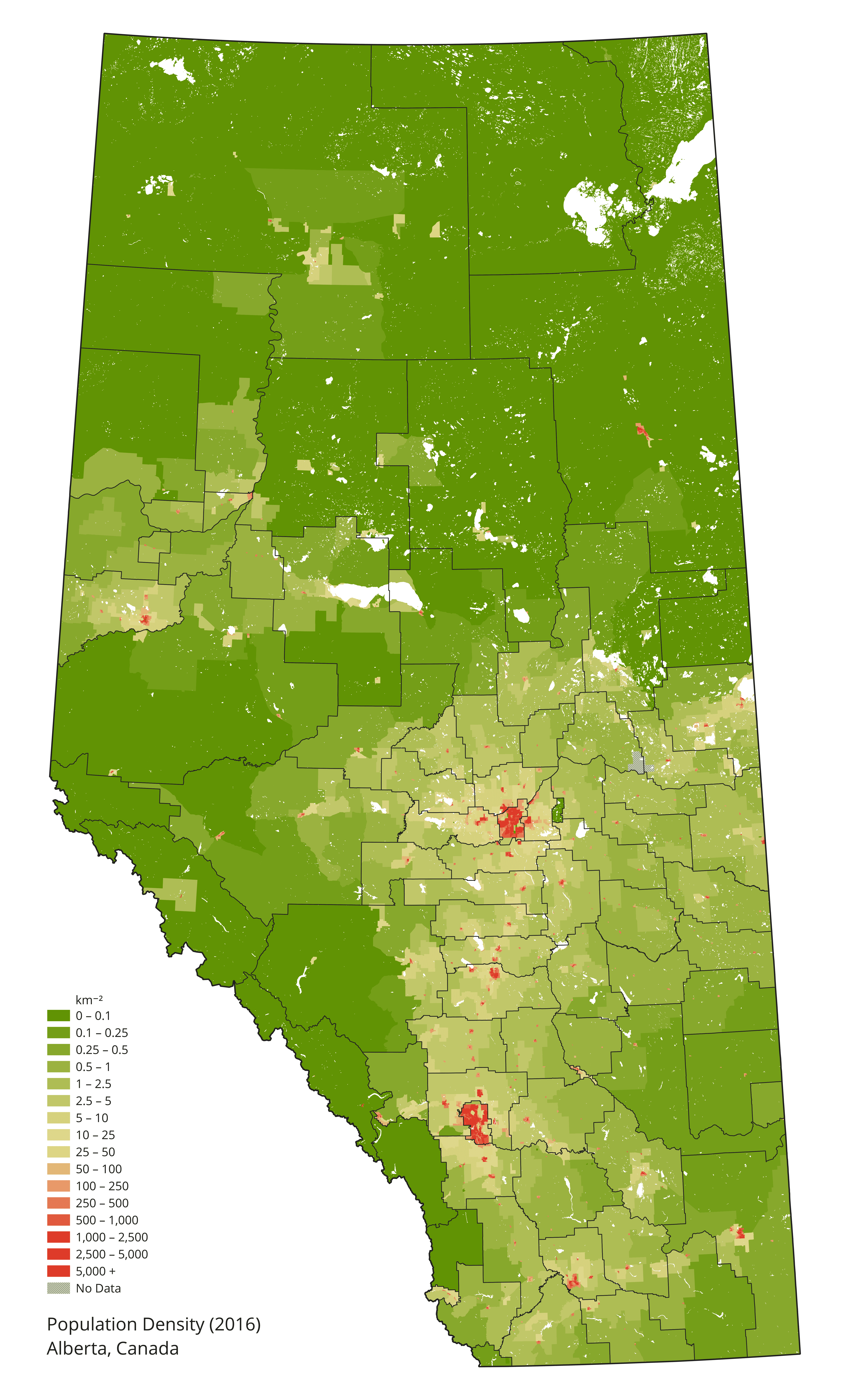
You can tell that I made this map while I was in the middle of getting a physics degree - it is way too cute to label a population density scale with the unconventional unit notation "km-2".
Simple
A couple years ago, I decided to revisit some of my Wikipedia maps. I like attention, so I figured it would be fun to make some highly visible work for some high-traffic geography articles (like, say, Alberta).
This is the Alberta population density map that I made and uploaded after a few years of having a career. It uses a custom mixture of municipal boundaries, arbitrarily selected by me.
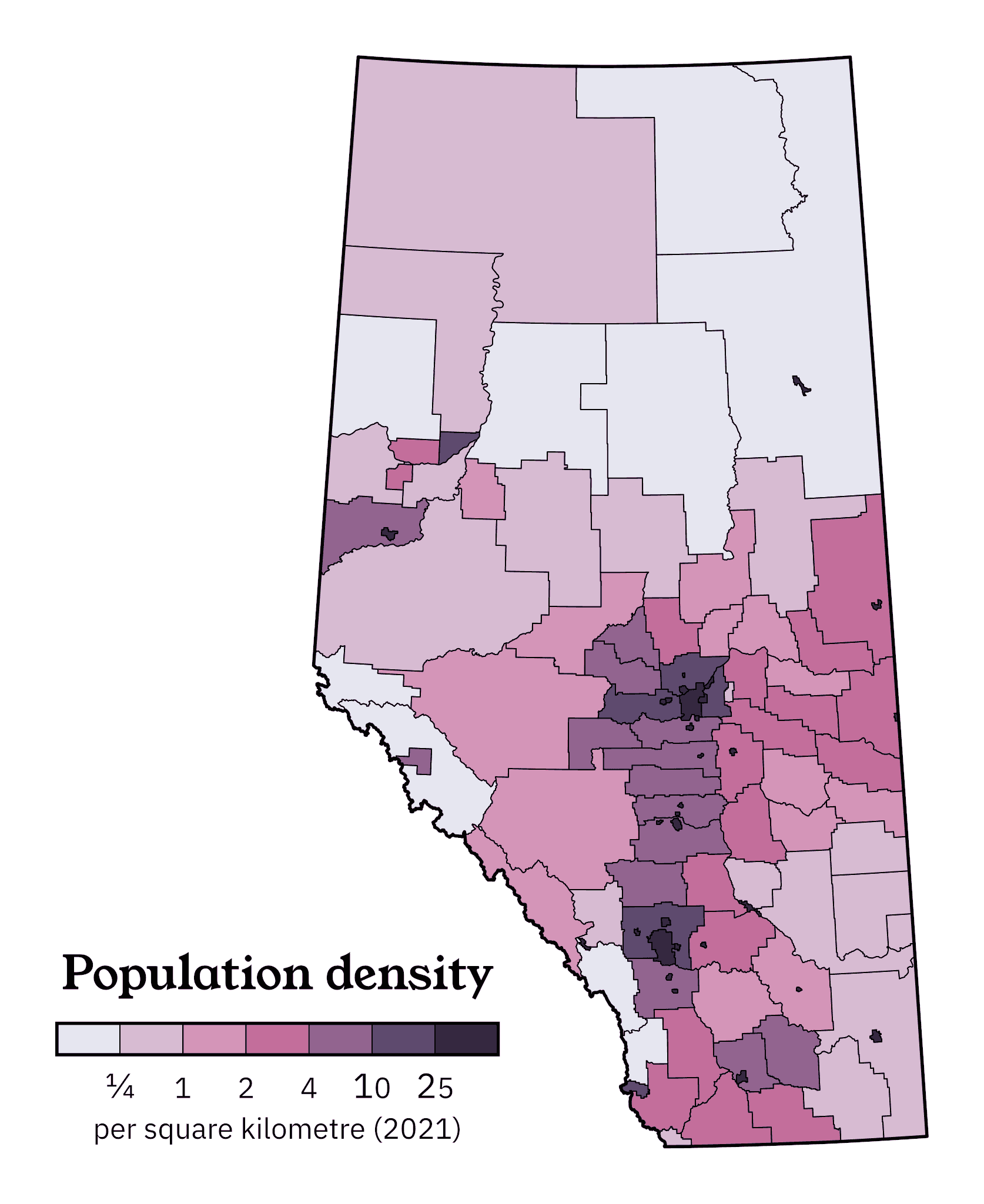
Simple vs. Complicated
When all you have is a hammer, everything looks like a nail.
I find a lot of beginner-intermediate GIS maps tend to confidently use the maximum available level of detail, and a lot of beginner-intermediate GIS users will often confidently say that more information always makes a better map.
Not so fast!
-
Visual complexity has nothing to do with effort. It sounds unbelievable unless you've personally played with GIS software, but because government census data is distributed at a very granular level, my 2016 Alberta density map is a great example of a completely out-of-the-box data visualization. I was able to create it in less than one hour.
-
A phrase like "better map" is incredibly loaded, despite being constantly thrown around by hobbyists. Most maps have some kind of intended purpose, and some kind of expected audience. Are you really confident that you understand the purpose AND that you're part of the audience?
Intended purpose
Both of these maps are intended for display on Wikipedia, where they will ultimately occupy a very small fraction of your monitor. Viewed in context, the idea of a supremely complicated map to end all maps (with SIXTEEN separate colour classes!) suddenly seems a bit out of place.
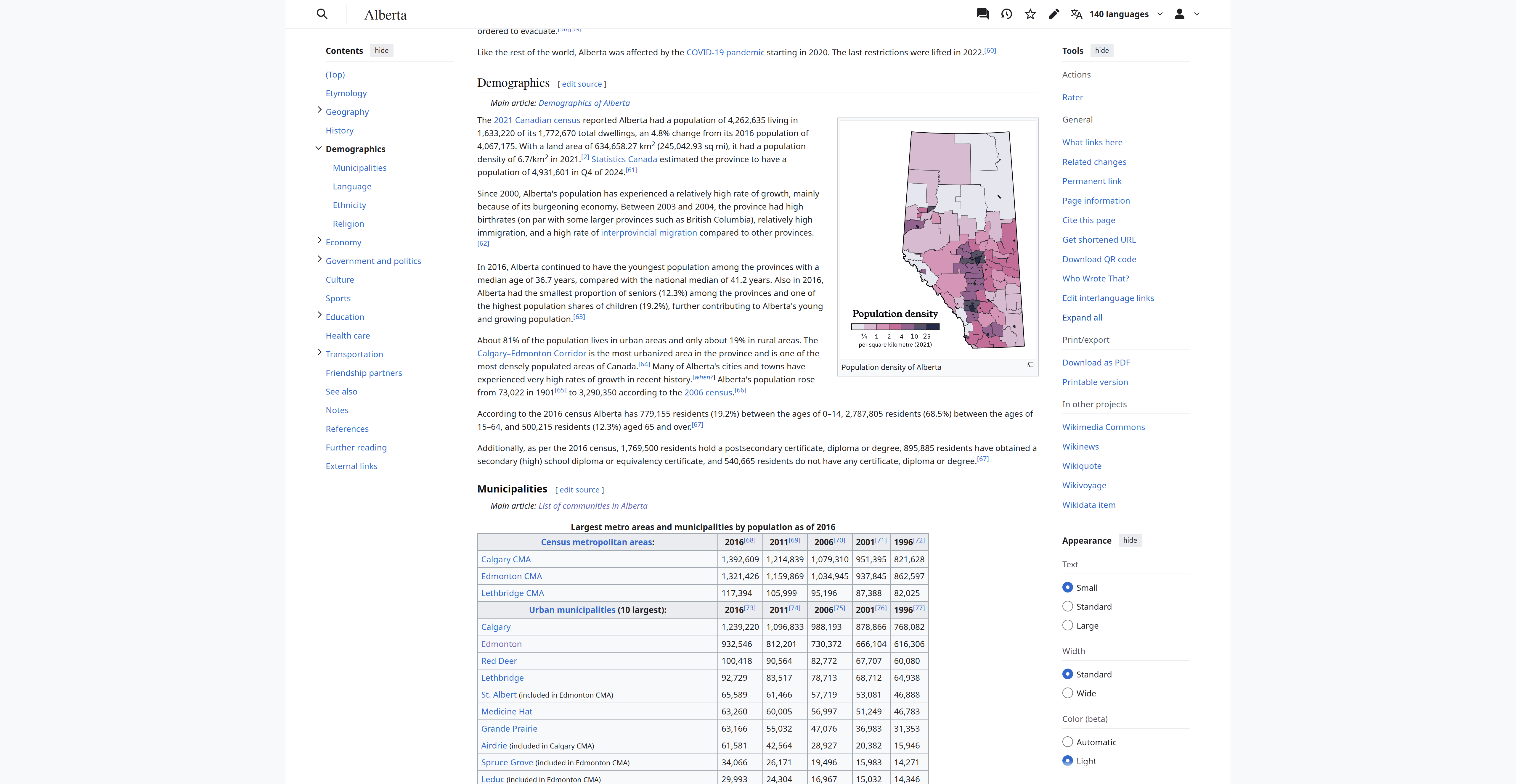
Yes, users technically have the option of clicking dense images to view them in more detail. We all want to flatter ourselves by imagining that our maps are the best things ever, so users will be certain to get a closer look at what we make. Wrong.
Try watching somebody else browse a web page that you really care about. You will be immensely disappointed. People evaluate the overwhelming majority of online material based on context, not comprehension.
Expected audience
I'm very familiar with Alberta's geography, so I love the extra detail in my 2016 map. The outline of the fertile Peace River Country is faintly visible against the province's northern boreal forest. You can see the rural population density decline in the southeast as rainfall becomes less reliable. Irrigation districts light up with a gentle yellow glow, human ingenuity surpassing the basic conditions of the harsh prairie climate.
This sounds really obvious, but introspection comes slowly to me: somebody who has spent 1,000 hours designing a self-published reference map of Alberta is not actually going to be an authority on what a normal person will find interesting.
Most Wikipedia readers still need to learn the basics:
- Alberta has two big cities.
- The corridor between them is densely urbanized.
- The north and the southeast are emptier.
- Most people who live in the northeast are concentrated into the single city of Fort McMurray.
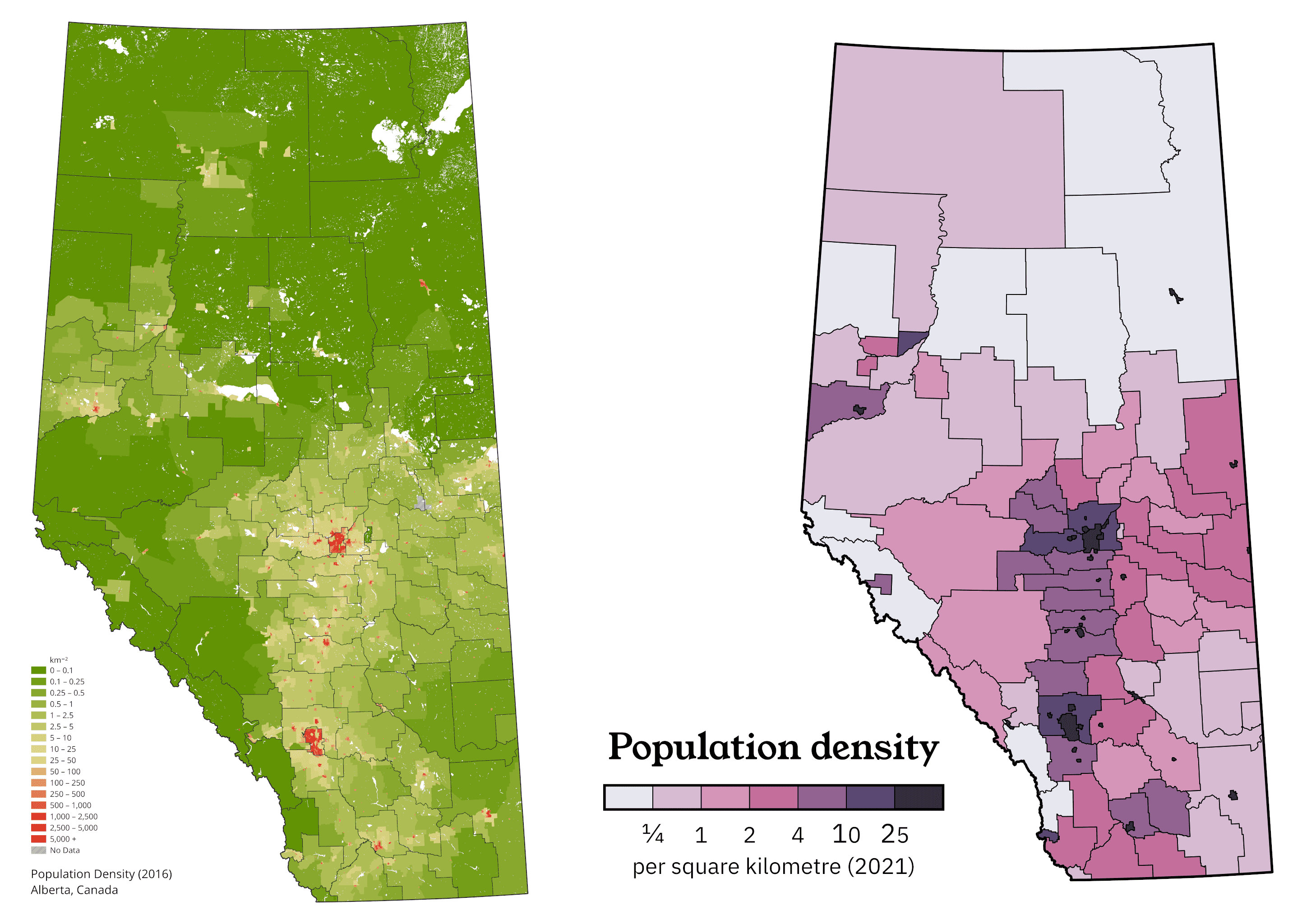
Both maps communicate these facts equally well.
Plus, the boundaries on the simple map correspond to counties and cities, which Albertans are generally aware of. Conversely, few Canadians have ever heard of a census dissemination area.
Which one's better?
Ha ha, nice try. I just said that a phrase like "better map" is incredibly loaded. You won't trick me with that one.
It's another huge mistake to think that maps portray objective truth without the faintest whisper of the creator's personality managing to escape. Remember that nerdy km-2 label? When I look at both of these maps, I can't avoid thinking about my personal growth and development between 2018 and 2023.
In other words, I probably find my 20-year-old self more annoying than anyone else on the planet.
From my perspective, the purple map is far superior.

